Rock fort temple
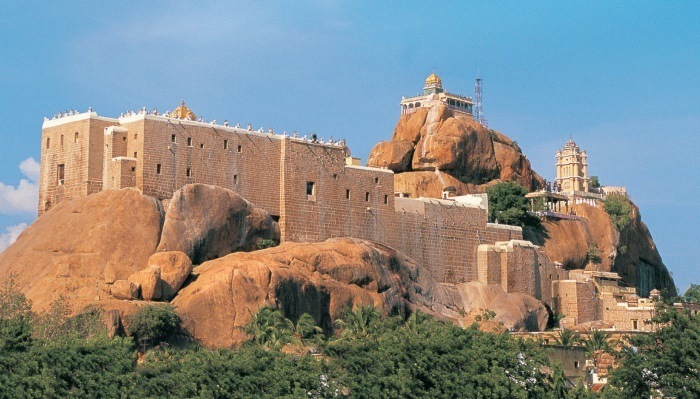
Tiruchirappalli (also called Trichy) is the fourth largest city in the state of Tamilnadu. Trichy is located at the heart of the state on the southern banks of the river Cauvery. Though there are several attractions in and around the city that tourists can afford to spend some time, the Tiruchirapalli Rock Fort, a historic fort and temple complex raised on an ancient rock, is the most popular tourist destination, often an integral part of the tour itinerary of the city. It is raised on a 273-foot high rock. You can find two Hindu temples inside the complex: the Shiva Temple and the Uchchi Pillaiyar Koil Temple.
Geologically, the high rock may be over one billion years old. There are other tourist attractions within the temple complex including the famous Nayaka-era fort and the Ganesha temple of the Pallava era. The fort was the scene of bloody battles between Madurai Nayakas, who used it as a military fort, and Carnatic, Bijapur and Maratha empires. The fort also turned the tides in favour of the British in India during the Carnatic wars, fought between many Indian rulers and British and French East India Company on either side.
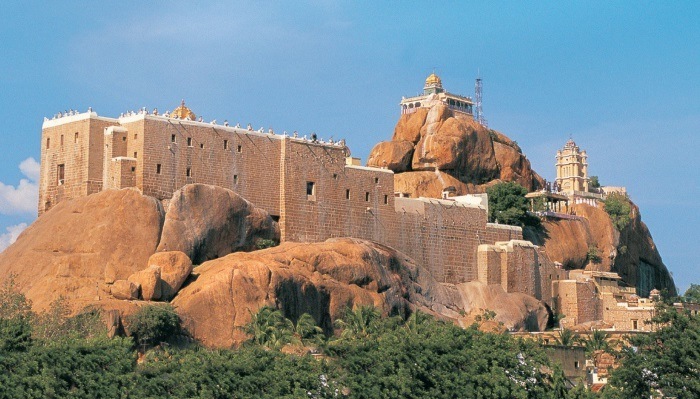
The Thayumanavar Temple is located in the Rockfort complex close to the base of it and was built by the great Pallava king Mahendravarman I in the 6th century AD. The main deity of the temple is Lord Shiva symbolized by the lingam and is worshiped as Thayumanavar. Mattuvar Kuzhalammai represents Shiva’s consort Parvati. The presiding deity is eulogized in the “Tevaram”, the Tamil Saiva canonical work compiled by the Nayanars, the tamil saint poets belonging to the 7th century.
On the eastern side is the Ucchi Pillayar koil, a Hindu temple of the 7th century, is dedicated to Lord Ganesha who was born to Lord Shiva and Parvati. It is situated on the top of Rockfort. Legend has it that Lord Ganesha ran from King Vibishana in this place, after setting up the Ranganathaswamy deity in Srirangam.
The temple houses a large-sized Ganesha and other rare deities and is host to the annual Vinayaka (Ganesha) Chathurthi festival. Devotees take great delight in listening to the classical musical concerts performed by several legendary Tamil Carnatic musicians in the temple, a tradition that has been in practise for over 70 years.
You can also witness the “Pallava Caves” constructed by the famous Pallava rulers during 580AD on the southern face of the Rockfort. One needs to climb 344 stone steps that are carved inside the rock from its entrance and over the rock near the top so as to reach the rock temple.
Jambukeswarar Temple (Thiruvanaikaval)
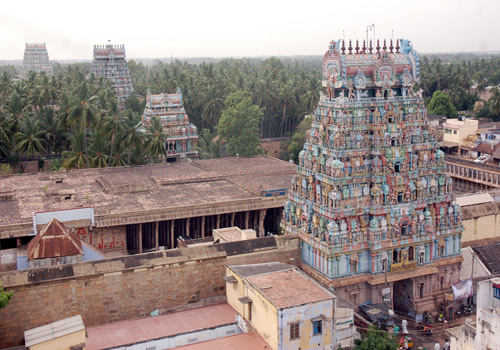
Jambukeswarar Temple (Thiruvanaikaval) is a famous Shiva temple in Tiruchirapalli (Trichy), in the state of Tamil Nadu state of BHARAT (India). The temple was built by Kocengannan (Kochenga Chola), one of the Early Cholas, around 1,800 years ago.
Thiruvanaikal Pancha Bhoota Stalam refers to the five Shiva temples, each representing the manifestation of the five prime elements of nature – space, air, fire, water, earth.[11] Pancha indicates five, Bhoota means elements and Sthala means place. All these temples are located in South India with four of these temples at Tamil Nadu and one at Andhra Pradesh. The five elements are believed to be enshrined in the five lingams and each of the lingams representing Shiva in the temple have five different names based on the elements they represent. In the temple, Shiva is said to have manifested himself in the form of water (Appu Lingam). The other four manifestations are Prithivi Lingam (representing land) at Ekambareswarar Temple, Akasa Lingam (representing sky) at Thillai Nataraja Temple, Chidambaram, Agni Lingam (representing fire) at Annamalaiyar Temple and Vayu Lingam (representing air) at Srikalahasti Temple.
It is one of the 275 Paadal Petra Sthalams, where all the four most revered Nayanars (Saivite Saints) have sung glories of the deity in this temple. The temple has inscriptions from the Chola period.
The second precinct of the temple with pillars sculpted during the Nayak period
he magnificient architecture seldom is the highlight of things for Hindu devotees visiting this temple in Srirangam. But if someone has ample time to explore the work of art that hasn’t even neglected the minute of details would find a plethora of interesting stuff.
The famous Vibudi Corridor around the Tiruvanaikaval in Trichi, india
The stone Vibudi Prakara (Compound Wall), which extends for over one mile, is two feet thick and over 25 feet in height.
Srirangam Sri Ranganathaswamy Temple
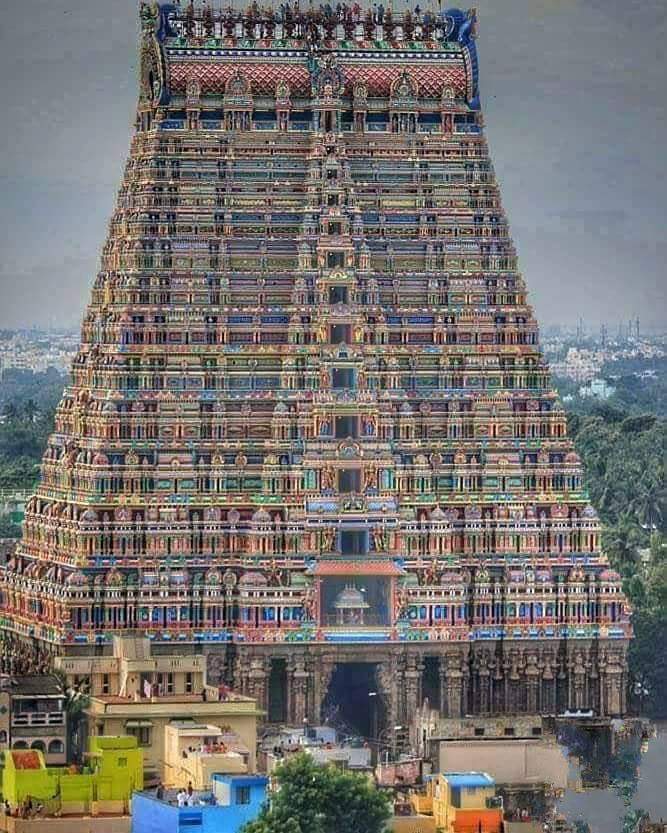
Sri Ranganathaswamy Temple’, also known as ‘Thiruvarangam’ is situated in Srirangam, Tiruchirapalli district of Tamilnadu. UNESCO recognized world heritage wonder. This famous temple is dedicated to Lord Vishnu and also most important one among the 108 Divya Desam Temples. Srirangam is an island located in the middle of the Rivers ‘Kaveri’ and ‘Kollidam’ and also a part of the city Tiruchirapalli. Thiruvarangam Sri Ranganathaswamy Temple is also known as ‘Thiruvaranga Tirupati’, ‘Periyakoil’, ‘Bhoologa Vaikundam’, and ‘Bhogamandabam’.
Maha Gopuram Sri Ranganathaswamy Temple
A main Gopuram among these 21 Gopurams of this temple is known as Rajagopuram is about 237 feet high having 12 Kalasams (a pot like structure) at its top. The deity Lord Sri Garudalwar in Sri Ranganathaswamy Temple is the biggest idol among all of the Vaishnavite temples.
As per the literature, it is said that the temple belongs to the Chola, Pandya, Hoysala and the Vijayanagar rulers who ruled the Tiruchirapalli district. Sri Ranganathaswamy Temple constitutes Seven Prakarams (passageway surrounding with big walls) around the temple which covers next to next each other and the seven great walls are referred as the Seven Worlds.
The presiding chief deity (Moolavar) of this Sri Ranganathaswamy Temple is Lord Vishnu named as ‘Lord Ranganathar’ in reclining posture on Adishesha (coiled serpent) facing south direction. Lord Ranganathar is also called by the names ‘Periya Perumal’, ‘Nam Perumal’, ‘Azhagiya Manavalan’. HIS consort Goddesses named as Goddess Boodevi and Goddess Sridevi(Goddess Lakshmi) is found just before the deity Lord Ranganathar.
Sri Ranganathaswamy Temple is considered the first and most important temples of all the 108 Divya Desam Temples dedicated to Lord Vishnu. The other deities of this temple are Lord Nam Perumal (Uthsavar), Goddess Ranganayaki, Lord Sudharshana Alwar, Lord Dhanvantri, Lord Pattabhi Ramar, Lord Venugopalan, Lords Nava Narasimhars, Lord Metu Azhagiasingar, Goddess Periya Piraati.
FESTIVALS
- Jestabishekam – June-July
- Pavithrothsavam – August –September
- Sri Jayanthi – August – September
- Oonjal – October-December
- Kaisiga Ekadesi – December – January
- Ekadesi – December-January
- Viruppan ( Chithirai Ther ) – March-April
- Ankurarpanam (Sprouting the seeds) – March – April
- Nagarasothanai (Street Investigation) – April–May
POOJA TIMINGS
- Viswaroopa Seva Timing – 06:00 AM To 07:15 AM
- Pooja Time -( No Darshan) 07:15 AM To 09:00 AM
- Darshan Timings 09:00 AM To 12:00 PM
- Pooja Time -( No Darshan) 12:00 Noon To 01:15 PM
- Darshan Timings – 01:15 PM To 05:45 PM
- Pooja Time -( No Darshan) 05:45 PM To 06:45 PM
- Darshan Timings 06:45 PM To 08:45 PM
- Viswaroopa Seva Timing 06:00 AM To 07:15 AM
Samayapuram Mariamman Temple
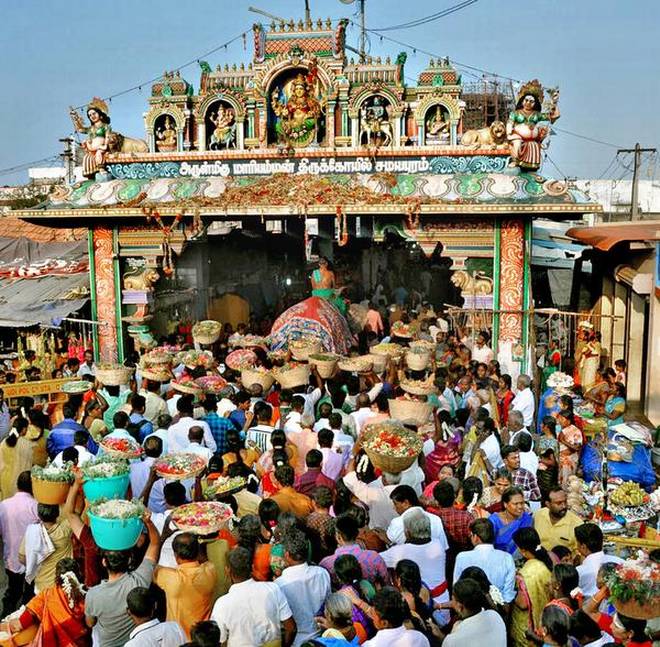
Samayapuram Mariamman Temple is popular among the Hindu followers. The origin of the temple dates back to the 18th century. It is believed that the temple was built under the rule of King Vijayaraya Chakkaravati. The rulers built the temple as a token of gratitude to the Goddess when they won the battle against their rivals. The idol is made of sand and clay and is believed to possess supernatural powers that can cure prolonged illnesses. During their visit to the temple, people buy metallic look-alikes of steel and silver. It is beleived that keeping them in touch with the body would heal the illness. The pilgrims also present the famous Mavilakku, a food made up of jaggery, ghee, and rice flour. Hundreds of pilgrims visit the temple during the sacred time of Mariamman and other festivals. The Thai Poosam is the prime festival that is celebrated here. The Chariot Festival in the month of April is another attraction. The chariot of the Goddess is carried in the streets of the town. The Samayapuram is a landmark of great religious and cultural heritage to the state.